
America's Swingometer Election
Why This British Election-Night Icon Is the Perfect Tool For The 2026 Midterms

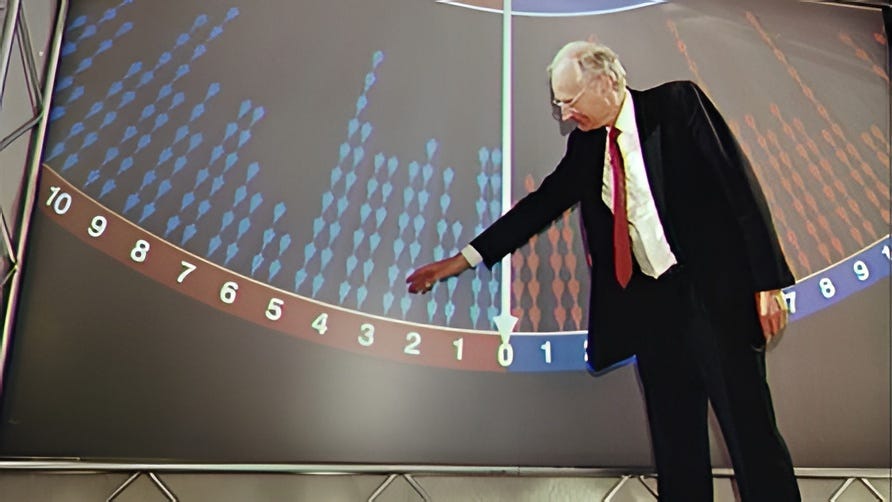
The “Swingometer” has been an integral fixture of British election nights since the 1950s. It’s time for Americans to adopt it.
What is the Swingometer?
The Swingometer is, simply put, a graphical depiction of the effect of a uniform swing towards one party or another in a parliamentary election.
Notably, it is not a rigorous seat-by-seat, race-by-race analysis. It is an estimating tool. It is one, however, that captures the outcomes of British elections well enough to capture also their public’s imaginations, and one that reflects the proximate cause of those outcomes well enough to feature frequently and speculatively in conversations leading up to, not just looking back on, election day.
Why the UK?
The Swingometer might at first seem more a quirk of British character as much as anything. It has certainly by now achieved a cultural penetration that would see it persist for some time, even were its practical usefulness to wane.
There is good reason, I think, it has become a British institution, and those reasons are key to understanding why its American time in the sun is overdue.
Firstly, it makes sense that the Swingometer has not found as great a purchase in proportional systems, like many of those on the European continent. In parliamentary systems, the swing is the outcome. Receive 30% of the vote, receive 30% of the seats. The reporting of results is flatly sufficient to understand the broad impact of the result without the need of a Swingometer-like decoder ring to reveal how that action at the polls translates to a legislative body’s composition.
It is the lumpy, imperfectly representative nature of Britain’s first-past-the-post elections that allow the Swingometer to shine. It is not abundantly clear, nor necessarily true, that a party securing a 10% larger share of the vote in parliamentary elections will translate into that party securing a 10% larger share of the seats. The Swingometer finds its purpose in illuminating the practical effect of electoral outcomes in such a system.
Then Why Not Us?
I was initially prepared at this point to wax poetic for a while about the stubborn character of American individualism as a force resistant to aggregating assumptions and de-personalizing head-to-head congressional contests. The only problem is that I find myself mostly disabused of those notions.
If the past decade has been a lesson in anything, it’s been a stark rebuke of any intrinsically unique force at work at the heart of the American character.
To the contrary, we’ve seen long-established American institutions dismantled, and long-held values core to our national identity cast aside, with the assent and acclaim (it is worth remembering, now that that support has rapidly begun to evaporate) of large swathes of public sentiment.
Much is uniquely American, but I’ve left by the wayside notions that Americans ourselves are singularly exceptional.
So, if not some deep-rooted individualism in the American spirit, why no Swingometer for the past 70 years of congressional elections?
In short, we simply haven’t cared enough about the overall national outcome.
Though the British system, like the American one, uses single-member, first-past-the-post districts, it is also, unlike the American one, a parliamentary system characterized by the selection of a Prime Minister by parliament.
Selecting a head of government in such a manner makes every parliamentary election in the UK similar in nature and stakes to a presidential one in the US. Historically, Americans haven’t cared nearly as much which party commands a majority in the US House.
That’s all starting to change.
Why Now?
Don’t get me wrong; political wonks have long recognized the tendency to view congressional elections as a national contest of sorts, coining our own dictionary of terms to describe these effects — headwinds, coattails, and, increasingly, waves. It’s the rise of the latter, both in fact and public imagination, that makes me think a US Swingometer is ready for its place in the sun.
What are “red wave” and “blue wave,” after all, if not just terms of are for significant, largely uniform swings? The 2025 and early 2026 off-cycle elections have provided useful data points. Though personalities big and small, commendable and condemnable alike, have the obvious ability to exert some force on electoral outcomes, the greater force seems to be national sentiment.
Candidates as diverse as Zohran Mamdani and Abigail Spanberger experienced similar victories on the same election night, despite very different personalities, campaigns, and constituencies.
Even with the same constituency, Spanberger, after a capable and competent campaign, outperformed deeply damaged Attorney General candidate Jay Jones by only a few points. The difference between a well-run campaign and a bad one, it would seem, was 4% of the vote. The rest of Spanberger’s 10-point swing from the last gubernatorial election was evidently simply the shift towards Democrats in broad partisan mood of the electorate.
A similar comparison is possible with the two extremely dichotomous recent State House special election victories for Democrats in Florida. One, a high-profile, well-funded attempt to swing the district containing Donald Trump’s own Mar-a-Lago home, achieved that goal with a 19-point swing over the prior election. How much did all that money, effort and attention matter? A long-shot Democrat in Tampa, outspent 10-1, won on the same night with an 8-point swing. Again, all the efforts of the campaign at best matched the magnitude of the underlying swing.
But what about all the gerrymandering this year? Won’t that mess up the idea of an outcome centered around a uniform swing?
Not at all. The underlying math simply adjusts to account for the fact that an R+20 may have just become an R+12. This impacts the amount of swing necessary for a dot to change colors, but doesn’t undermine the utility of the Swingometer at all. In fact, the more unfair the districts, the less intuitive it becomes how they will react to changes in national mood, and the more useful a visualization of that information becomes.
So what say you, fellow Americans? I say 2026 is primed to be America’s Swingometer election.